Oral Presentation ESA-SRB-NZSE-CaSR 2026 in conjunction with ENSA
Early indicators of ovulation identified through remote monitoring in pigs (143322)
Artificial insemination (AI) is the dominant swine mating practice globally, which relies on highly variable and subjective observations of oestrus behaviour, to inform timing. To compensate for this lack of precision, multi-dose AI programs are utilised, but a single insemination could be possible with more effective methods of predicting ovulation. Imaging and thermography have shown promising results for assessing changes in behaviour and temperature approaching ovulation; however, limitations include lack of individual tracking and high labour requirements (1-4). The present study aimed to determine whether ear-mounted accelerometer devices, which remotely quantify individualised activity and auricular skin temperature, could be used to predict ovulation.
At weaning, 32 sows were group housed and accelerometer devices attached. Movement was categorised as resting, active, or foraging (eat/drink), by the software algorithm using minute-interval tri-axial data. Transrectal ultrasounds were performed six hourly from three days post-weaning, to assess follicular development and determine time of ovulation. Accelerometer outputs were aggregated into hourly mean proportions and analysed using a linear mixed model, with timepoint relative to ovulation as a fixed effect, and sow fitted as the random term (5).
A sustained reduction in resting, matched by a corresponding rise in active behaviours were observed between 28−25h pre-ovulation (Fig 1; P<0.05). Overall, there were no significant changes between consecutive temperature observations; however, temperatures were lowest in the period 6−0h pre-ovulation (P<0.05).
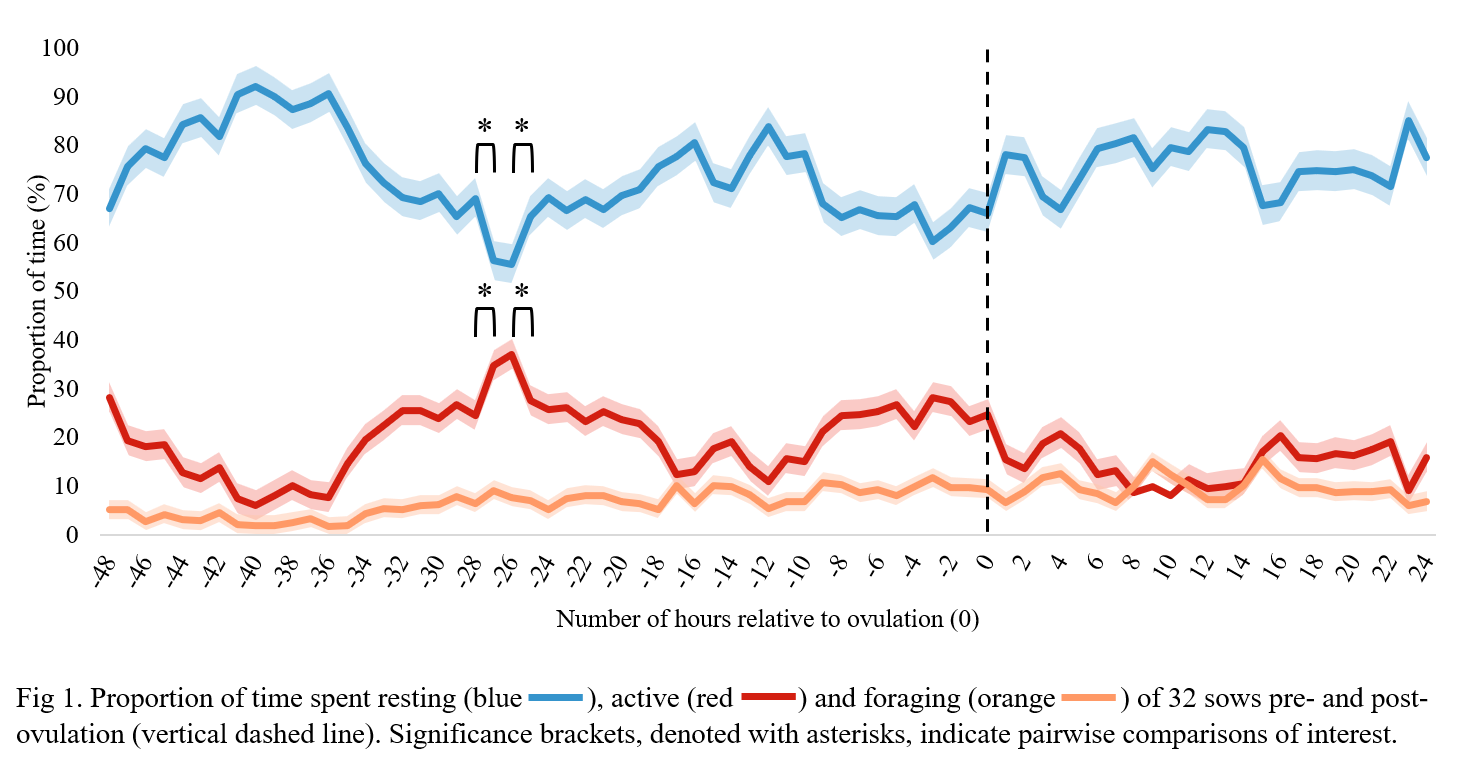
These results show potential for accelerometer technology as an oestrus detection tool, providing informative indicators within 28h of ovulation. Accuracy may be enhanced with specific algorithms to detect oestrus-related behaviours such as mounting. Producers could benefit from this technology through utilising early alerts and after-hours data to concentrate labour efforts and implement timed AI. Future work should utilise these prediction windows to develop real-time alert capabilities.
Acknowledgements: Supported in part by Australasian Pork Research Institute Ltd.
- 1. Xu Z, Zhou J, Bromfield C, Lim TT, Safranski TJ, Yan Z, et al. Automated oestrous detection in sows using a robotic imaging system. Biosyst Eng. 2024;244:134-45.
- 2. Almadani I, Abuhussein M, Robinson AL. YOLOv8-Based Estimation of Estrus in Sows Through Reproductive Organ Swelling Analysis Using a Single Camera. Digital. 2024;4(4):898-913.
- 3. Lee JH, Lee DH, Yun W, Oh HJ, An JS, Kim YG, et al. Quantifiable and feasible estrus detection using the ultrasonic sensor array and digital infrared thermography. J Anim Sci Technol. 2019;61(3):163-9.
- 4. Zheng H, Zhang H, Song S, Wang Y, Liu T. Automatic detection of sow estrus using a lightweight real-time detector and thermal images. Int J Agric Biol Eng. 2023;16(3):194-207.
- 5. Posit team. RStudio: Integrated Development Environment for R. 4.5.2. Posit Software, PBC, Boston, MA. 2025. Available from: http://www.posit.co/.