Oral Presentation ESA-SRB-NZSE-CaSR 2026 in conjunction with ENSA
Beyond ‘normal’ thyroid function tests: Resistance to thyroid hormone alpha (RTH) identified through reverse phenotyping (144060)
Background:
Resistance to thyroid hormone alpha (RTHα) arises from heterozygous THRA variants encoding a dominant-negative TRα1 receptor. 29 variants are reported. As TRα1 is not the dominant hypothalamic–pituitary-thyroid axis isoform, TSH remains normal and diagnosis is readily overlooked.
Case:
A 40-year-old Tongan woman was referred after her 12-year-old son's whole exome sequencing for moderate intellectual impairment (FSIQ 54), speech delay, macrocephaly, bilateral club feet, hypotonia, Perthes disease, anaemia and raised CK, identified a heterozygous THRA variant, c.802G>A, p.(Asp268Asn) - a VUS later confirmed in her.
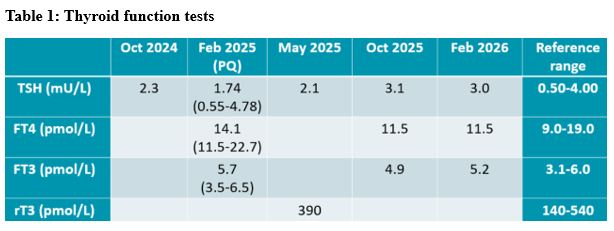
She has type 2 diabetes and class III obesity (BMI 41.8 kg/m²). Serial thyroid function was persistently unremarkable (Table 1). Examination demonstrated cold intolerance, fatigue, constipation, slow speech, alongside coarse facies, ptosis, flattened nasal bridge, brachydactyly, doughy skin, short stature and normocytic anaemia. Echocardiography was normal. Indirect calorimetry suggested low resting energy expenditure. Thyroxine was titrated to 150 mcg daily with monitoring of resting metabolic rate, heart rate, SHBG and symptom burden.
Discussion:
RTHα affects TRα1-expressing tissues: brain, bone, gut, heart and haematopoietic marrow (1). Its biochemical signature is subtle; low/low-normal FT4, high/high-normal FT3, reduced FT4:FT3 ratio, and low reverse T3 from impaired DIO3-mediated T3 catabolism. Most pathogenic variants cluster in C-terminal ligand-binding domain, generating receptor that neither binds T3 nor releases corepressor, and inhibits wild-type receptors (2, 3).
We discuss how the VUS could be reclassified as likely pathogenic under ACMG criteria, supported by real-world cases (4). Genotype dictates phenotype severity (5). Since thyroxine rescues only what the mutant receptor permits: skeletal and growth parameters improve, while macrocytosis, red cell mass, resting energy expenditure and muscle CK largely do not (5). For our patient, whose variant lacks functional characterisation, the response to a thyroxine trial will be informative and, with absent vitro data, may be the most accessible evidence of receptor competence.
- Bochukova E, Schoenmakers N, Agostini M, Schoenmakers E, Rajanayagam O, Keogh Julia M, et al. A Mutation in the Thyroid Hormone Receptor Alpha Gene. New England Journal of Medicine.366(3):243-9.
- Moran C, Schoenmakers N, Agostini M, Schoenmakers E, Offiah A, Kydd A, et al. An Adult Female With Resistance to Thyroid Hormone Mediated by Defective Thyroid Hormone Receptor α. The Journal of Clinical Endocrinology & Metabolism. 2013;98(11):4254-61.
- Moran C, Chatterjee K. Resistance to thyroid hormone due to defective thyroid receptor alpha. Best Pract Res Clin Endocrinol Metab. 2015;29(4):647-57.
- Yalçın HY, Cinleti T, Yel S, Mutlu MB. Dual Diagnosis of Nongoitrous Congenital Hypothyroidism-6 and Snijders Blok-Campeau Syndrome. Mol Syndromol. 2024;15(3):240-6.
- Moran C, Agostini M, McGowan A, Schoenmakers E, Fairall L, Lyons G, et al. Contrasting Phenotypes in Resistance to Thyroid Hormone Alpha Correlate with Divergent Properties of Thyroid Hormone Receptor α1 Mutant Proteins. Thyroid. 2017;27(7):973-82.