Oral Presentation ESA-SRB-NZSE-CaSR 2026 in conjunction with ENSA
Hiding in plain sight: hypercalcaemia associated with calcium sulphate beads (143864)
Hypercalcaemia associated with calcium sulphate bead (CSB) implantation is uncommon (incidence 5.4%), typically transient and self-limiting.(1) We report a fatal case of hypercalcaemia associated with CSBs that required renal replacement therapy (RRT) and discuss diagnostic challenges, risk factors and management considerations.
A 58-year-old woman developed severe hypercalcaemia and acute-kidney-injury (AKI) following total hip arthroplasty complicated by periprosthetic acetabular fracture and infection. Forty millilitre absorbable antibiotic-impregnated calcium sulphate beads (CSBs) were placed under the acetabular liner and into the abdominal wound.
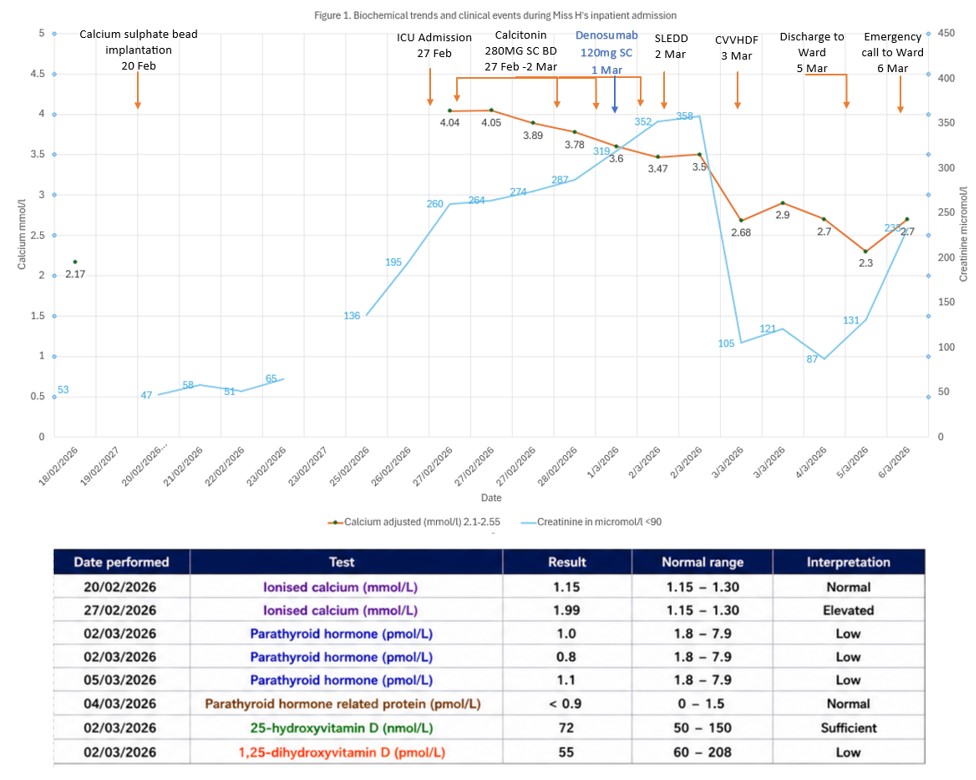
Oliguric AKI manifested on post operative day (POD) 5, progressing to anuria by POD7 and severe symptomatic hypercalcemia (4.04mmol/L, RI 2.1-2.55mmol/L). PTH was suppressed, PTHrP was undetectable, 25-hydroxyvitamin-D was replete, biochemical and radiological evidence of malignancy were absent (Figure 1). Serial Pelvic x-rays confirmed CSB resorption. Management included intravenous fluids (IVF), loop-diuretics, calcitonin, denosumab and RRT. Hypercalcaemia resolved on POD12 following RRT. Multi-organ failure resulted in death on POD14. Risk factors included prolonged immobilisation, atrophic left kidney (vesicoureteric reflux), high CSB volume, pelvic implantation and rapid CSB dissolution.
This case demonstrates unusually severe, prolonged CSB-related hypercalcaemia requiring RRT and resulting in death, the first in the literature. Effective management requires prevention by minimising CSB exposure, early detection with daily calcium monitoring pre and post-exposure and aggressive treatment.(2) Optimal treatment of the persisting and non-rapidly reversible calcium source is unclear. There have been no reported bead explants, but combinations of IVF, calcitonin, anti-resorptive and RRT have been successful.(3,4) Early RRT may assist in clearing the implanted calcium reservoir. Whilst use of anti-resorptive agents have been reported in the literature, due to the mechanism of hypercalcaemia, the role of these agents is unclear and risks subsequent hypocalcaemia particularly in patients with chronic renal disease. Further research is needed to understand pathophysiology and to determine the optimal management of CSB-associated hypercalcaemia.
- Kallala R, Harris WE, Ibrahim M, et al. Stimulan calcium sulphate beads in revision lower limb arthroplasty: safety and complications. Bone Joint Res. 2018;7:570-9. doi:10.1302/2046-3758.710.BJR-2017-0319.R1.
- Jung Y, Moe K, Torres EA, Kalantar-Zadeh K, Hanna RM. Unique case of profound iatrogenic hypercalcemia in a patient with recent orthopedic prosthetic infection. Clin Nephrol Case Stud. 2020;8:91-5. doi:10.5414/CNCS110179.
- Demidowich AP, Motevalli M, Yi K, et al. Severe hypercalcemia after hip implantation of calcium sulfate antibiotic beads. J Community Hosp Intern Med Perspect. 2025;15:107-10. doi:10.55729/2000-9666.1449.
- Lane K, Kim S, Grock S, Freeby M. Hypercalcemia after placement of antibiotic-loaded calcium sulfate beads. J Endocr Soc. 2020;4(Suppl 1):MON-345. doi:10.1210/jendso/bvaa046.1173.