Lightning Talk + Poster ESA-SRB-NZSE-CaSR 2026 in conjunction with ENSA
Management of aromatase inhibitor-associated bone loss in women with hormone receptor-positive breast cancer: a single centre experience (143847)
Aromatase inhibitors (AI) are frequently used to treat hormone receptor-positive breast cancers but can accelerate bone loss and increase fracture risk. We aimed to assess management of AI-associated bone loss in a tertiary Osteoporosis Refracture Prevention (ORP) service.
We performed a retrospective audit of pre- and post-menopausal women receiving AI who attended Westmead Hospital’s ORP clinic between February 2019–February 2026. Clinical characteristics, biochemistry, and bone mineral density (BMD) were analysed.
Eighty-seven women were included. Mean age 65±10.8 years. Menopausal age 48±5.7 years (72(83%) natural, 4(5%) surgical, 11(13%) due to goserelin). Letrozole was the most common AI (81/87,93%). Median AI exposure was 3.5(1.8–5.2) years. Median follow-up was 1.5(0.7–2.4) years. Before AI therapy, 82(94%) underwent baseline DEXA; 49(60%) had osteopenia, 29(35%) osteoporosis, and 18(21%) had prior fragility fracture.
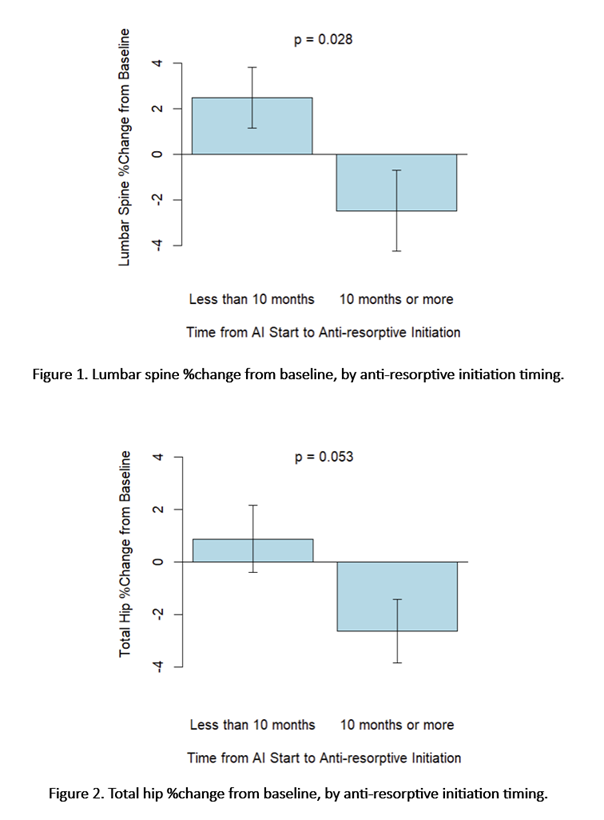
Anti-resorptives were prescribed in 77(88%), most commonly zoledronic acid (35/77, 45%; 31 received 5mg annually, 4 received 4mg q6monthly), oral bisphosphonates (25/77, 32%), and denosumab (16/77, 21%). Median time from AI commencement to anti-resorptive therapy was 10(-3–23) months. Bone turnover markers declined over time. Earlier anti-resorptive initiation (<10 months from AI commencement) was associated with greater lumbar spine BMD %change than later initiation (2.48±7.26% vs -2.46±9.15%;p=0.028). A similar trend was observed at the total hip but was not significant (0.87±6.51% vs -2.63±5.90%;p=0.053)(Figure 1,2).
Twelve(14%) sustained a new fragility fracture (including 3 hip fractures) despite anti-resorptives with no new clinical vertebral fractures, 7 of whom had delayed anti-resorptive start. Median time from AI start to fracture was 29(18–60) months. AI therapy was discontinued in 11(13%) due to worsening BMD or incident fracture despite anti-resorptives.
Anti-resorptives were frequently prescribed and associated with improved lumbar spine BMD, particularly with earlier initiation, supporting timely intervention to mitigate AI-associated bone loss. Development of strategies leading to concurrent initiation of anti-resorptives in at-risk women commencing AIs is warranted.