Oral Presentation ESA-SRB-NZSE-CaSR 2026 in conjunction with ENSA
A single centre experience of endocrine late effects following allogeneic bone marrow transplantation (143822)
Allogeneic bone marrow transplant (allo-BMT) indications have expanded over the last two decades(1), with annual activity quadrupling and non-relapse mortality halving, improving three-year overall survival by 14%(2,3). Yet, the long-term burden of endocrine complications remains poorly characterised. This study examined prevalence, cumulative incidence, and risk factors for endocrine late effects.
This retrospective cohort study included allo-BMT recipients transplanted between 2015 and 2025 who attended ≥ 1 follow-up at Westmead Hospital. Prevalence and risk factors were compared using univariate chi-square, Fisher's exact, or Mann-Whitney U tests. Cumulative incidence was estimated using Kaplan-Meier analysis.
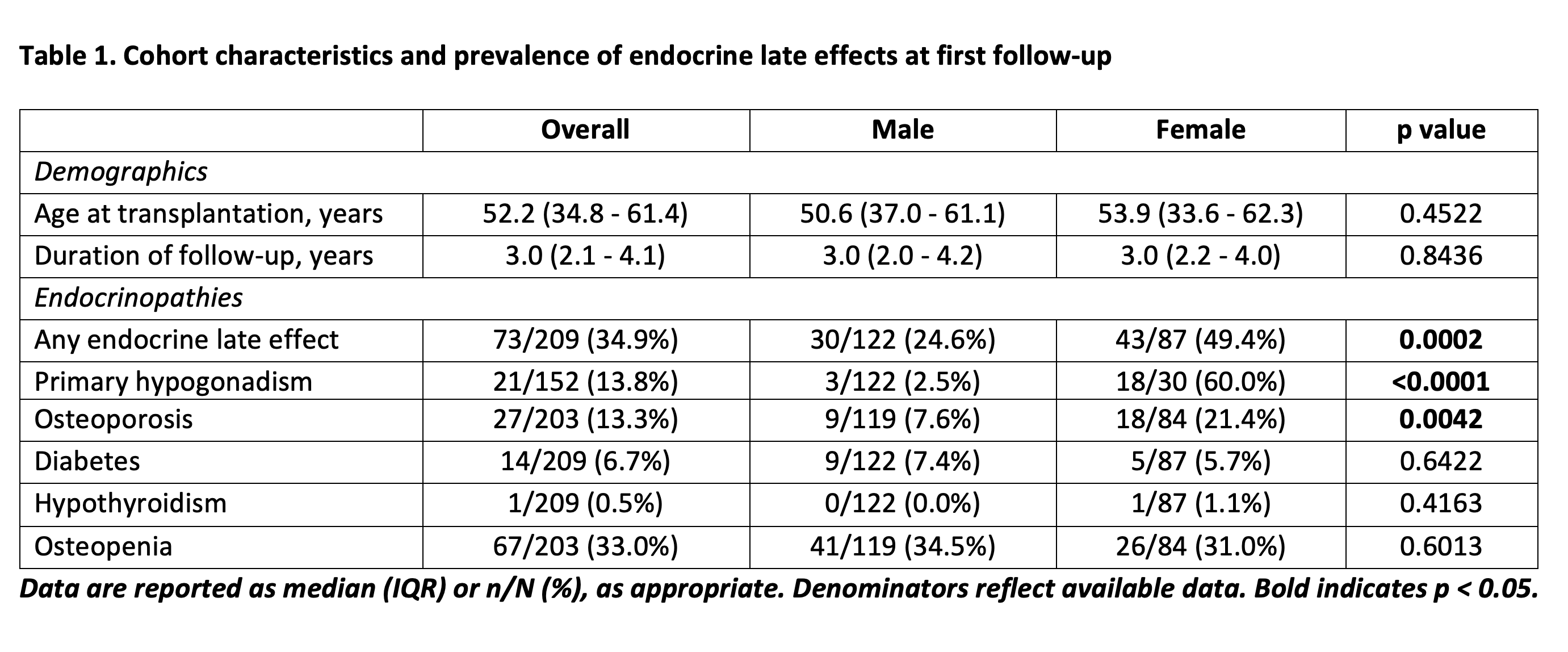
Among 312 recipients, 209(67%) had ≥ 1 follow-up. Median transplant age was 52.2(34.8-61.4) years. Median follow-up was 3.01(2.1-4.1) years. Endocrine late effects were present in 34.9% of recipients at first follow-up and 42.1% throughout follow-up. Primary hypogonadism (13.8%) and osteoporosis (13.3%) were the most common overt endocrine late effects. Both effects were more prevalent in females at first follow-up (60.0% vs 2.5%; p<0.0001; 21.4% vs 7.6%; p=0.0042) and throughout follow-up (71.0% vs 4.1%, p<0.0001; 21.2% vs 9.9%, p=0.0241). No significant sex differences were observed for diabetes, hypothyroidism, or osteopenia. At three years post-transplant, the cumulative incidence for any new-onset endocrine late effect was 25.5%. Of the most common endocrine late effects, the three-year post-transplant cumulative incidence was 29.2% for osteopenia, 18.3% for primary hypogonadism, and 12.5% for osteoporosis. At transplant, patients with osteoporosis were older (58.3 vs 51.8 years; p=0.017), whereas those with primary hypogonadism were younger (33.4 vs 47.2 years; p=0.005). Tacrolimus exposure was associated with osteoporosis (40.0% vs 17.7%; p=0.006). Pre-transplant chemotherapy was more common in patients with primary hypogonadism (96.2% vs 79.8%; p=0.048).
Endocrine late effects were common, particularly among females. Persistent endocrine late effects throughout follow-up warrant age-, sex-, and treatment-tailored endocrine surveillance. Larger, longer-term cohorts are needed to clarify risk factor effects.
- Agency for Clinical Innovation. Blood and marrow transplant long-term follow-up clinical practice guideline. Sydney: NSW Agency for Clinical Innovation, 2022.
- Cibich A, Wechalekar G, Shanmuganathan N, et al. Long-term survival gains after allogeneic hematopoietic stem cell transplant are driven by reductions in non-relapse mortality: a 35-year statewide Australian cohort study. Transplant Cell Ther. 2026. Epub ahead of print January 2026. https://doi.org/10.1016/j.jtct.2026.01.024
- Kliman D, Tran S, Kennedy G, et al. The improvement in overall survival from unrelated donor transplantation in Australia and New Zealand is driven by a reduction in non-relapse mortality: A study from the ABMTRR. Bone Marrow Transplant 2022; 57(6): 982–989. https://doi.org/10.1038/s41409-022-01683-w