Poster Presentation ESA-SRB-NZSE-CaSR 2026 in conjunction with ENSA
Rituximab as a therapeutic agent for refractory Insulin Antibody Syndrome (#425)
Insulin autoimmune syndrome (IAS), or Hirata disease, is a rare cause of endogenous hyperinsulinaemic hypoglycaemia, estimated to affect 1 in 1 million people worldwide, characterised by elevated insulin and positive insulin autoantibodies1. Treatment is guided by scattered case reports without comparative trials, and refractory disease remains a clinical challenge.
We present a 78-year-old man who presented as a stroke call with slurred speech, on a background of six months of worsening hypoglycaemic episodes previously misattributed to TIAs. Capture of spontaneous hypoglycaemia (glucose 2.7 mmol/L) revealed grossly elevated insulin level (>6945 pmol/L) and C-peptide, with imaging excluding insulinoma. Strongly positive insulin antibodies (titre 1/1000) confirmed IAS. Diazoxide and corticosteroids reduced hypoglycaemia, complicated by severe immune thrombocytopenia requiring diazoxide cessation and IVIG, but symptomatic hypoglycaemia and persistent antibodies remained despite ongoing therapy.
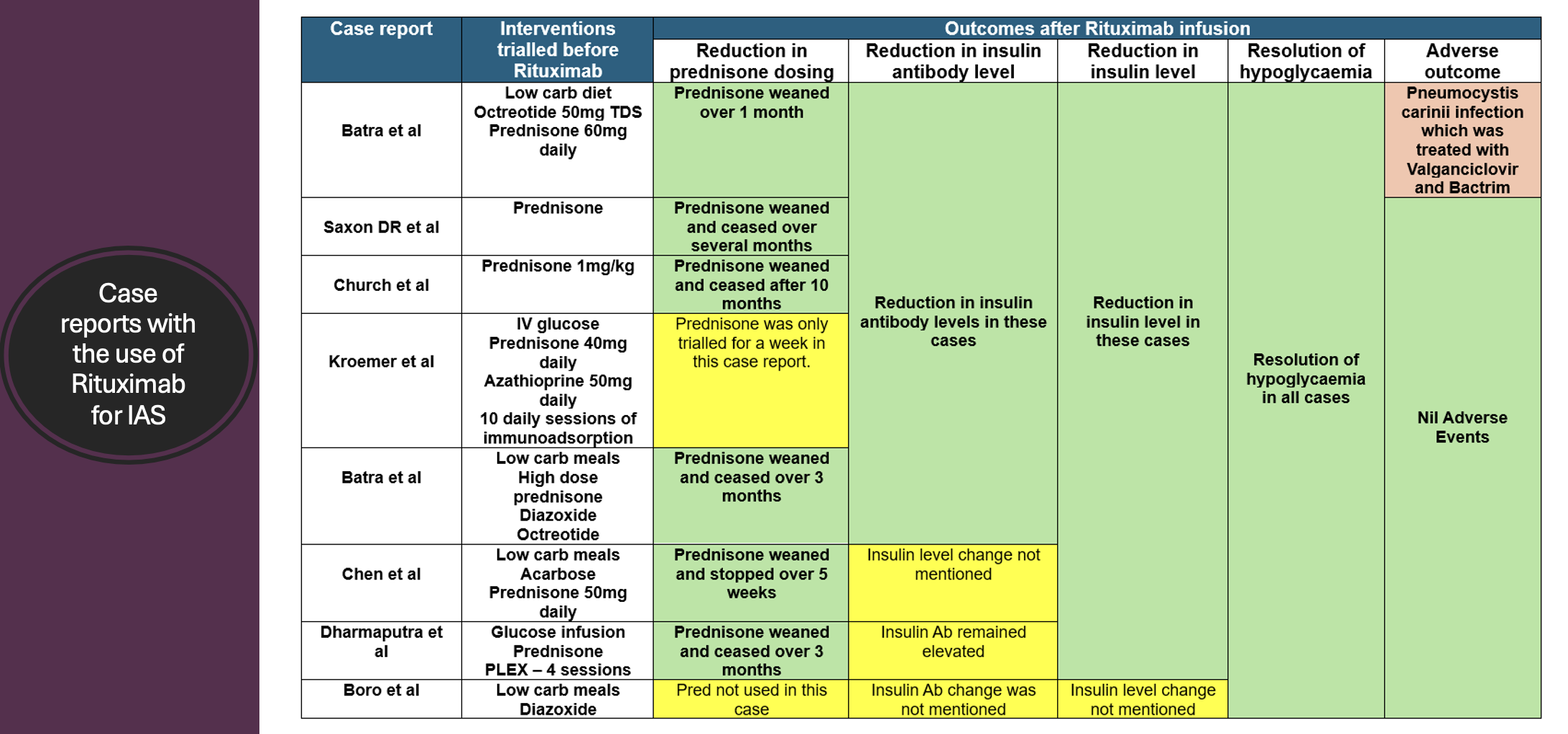
Rituximab, a CD20-targeted monoclonal antibody that depletes B cells, was commenced for steroid-refractory disease, supported by TrialNet data showing sustained suppression of insulin autoantibodies after a single course2. Following two infusions, our patient's antibody titre fell from 1/4 to 1/2 within three weeks, hypoglycaemic episodes reduced, and diazoxide and prednisone doses were successfully weaned. A review of the rituximab literature identified at least eight published case reports in IAS (see Figure 1), all demonstrating complete or near-complete resolution of hypoglycaemia and successful steroid weaning, with only one reported adverse event (opportunistic infection on concurrent prednisone)3-10.
This case adds to the growing evidence for rituximab as an effective, well-tolerated, steroid-sparing therapy in IAS.
Figure 1
- 1. Macchia E, Falorni A, et al. Insulin autoimmune syndrome (Hirata disease): a comprehensive review fifty years after its first description. Diabetes Metab Syndr Obes. 2023;16:1–10. Available from: https://www.dovepress.com/insulin-autoimmune-syndrome-hirata-disease-a-comprehensive-review-fift-peer-reviewed-fulltext-article-DMSO
- 2. Yu L, Herold K, Krause-Steinrauf H, et al. Rituximab selectively suppresses specific islet antibodies. Diabetes. 2011;60(9):2560–2565.
- 3. Saxon DR, McDermott MT, Michels AW. Novel management of insulin autoimmune syndrome with rituximab and continuous glucose monitoring. J Clin Endocrinol Metab. 2016;101(5):1931–1934. doi:10.1210/jc.2016-1097.
- 4. Church D, Hunter RW, Lyall M, et al. Resolution of Hypoglycemia and Cardiovascular Dysfunction After Rituximab Treatment of Insulin Autoimmune Syndrome. Diabetes Care. 2017;40(7):e80–e82. doi: 10.2337/dc17-0264
- 5. Batra CM, Kumar K, Goyal M. Steroid-refractory insulin autoimmune syndrome treated with rituximab and continuous glucose monitoring. Cureus. 2021 Aug 4;13(8):e16935. doi:10.7759/cureus.16935. PMID: 34430127; PMCID: PMC8375604.
- 6. Boro H, Gupta U, Singh C, Malhotra R, Khadgawat R. Continuous glucose monitoring and rituximab treatment in insulin autoimmune syndrome. Diabetes & Metabolic Syndrome: Clinical Research & Reviews. 2021;15(6):102242
- 7. Chen AX, Beligaswatte A, White G, Burt MG. Rituximab for treatment of refractory insulin autoimmune syndrome associated with non-Hodgkin B-cell lymphoma. Clin Endocrinol (Oxf). 2019 Apr;91(1):230–2.
- 8. Dharmaputra RK, Wan KL, Samad N, Herath M, Wong J, Sarlos S, Holdsworth SR, Naderpoor N. A novel approach to a rare case of non-islet cell hypoglycaemia. Endocrinol Diabetes Metab Case Rep. 2021 Jun 14;2021:21-0040. doi: 10.1530/EDM-21-0040.
- 9. Kroemer TM, Erler A, Tsourdi E, Gruber M, Tselmin S, Julius U, Aringer M, Hofbauer LC, Rachner TD. Immunoadsorption followed by rituximab as a definitive treatment for insulin autoimmune syndrome (Hirata syndrome): a case report. Diabetes Care. 2018 Mar;41(3):e23–e24. doi: 10.2337/dc17-1974.
- 10. Batra CM, Jain S, Kumar KP, Goyal M, Kachroo V, Takkar S, Yadav R. Spontaneous hypoglycaemia due to insulin autoimmune syndrome in six cases, response to steroid therapy and rituximab. Indian J Endocrinol Metab. 2024 Jun 26;28(3):295–301. doi: 10.4103/ijem.ijem_378_23